
PTSD: Why Your Brain Won't Let Go and How Hypnotherapy Can Help
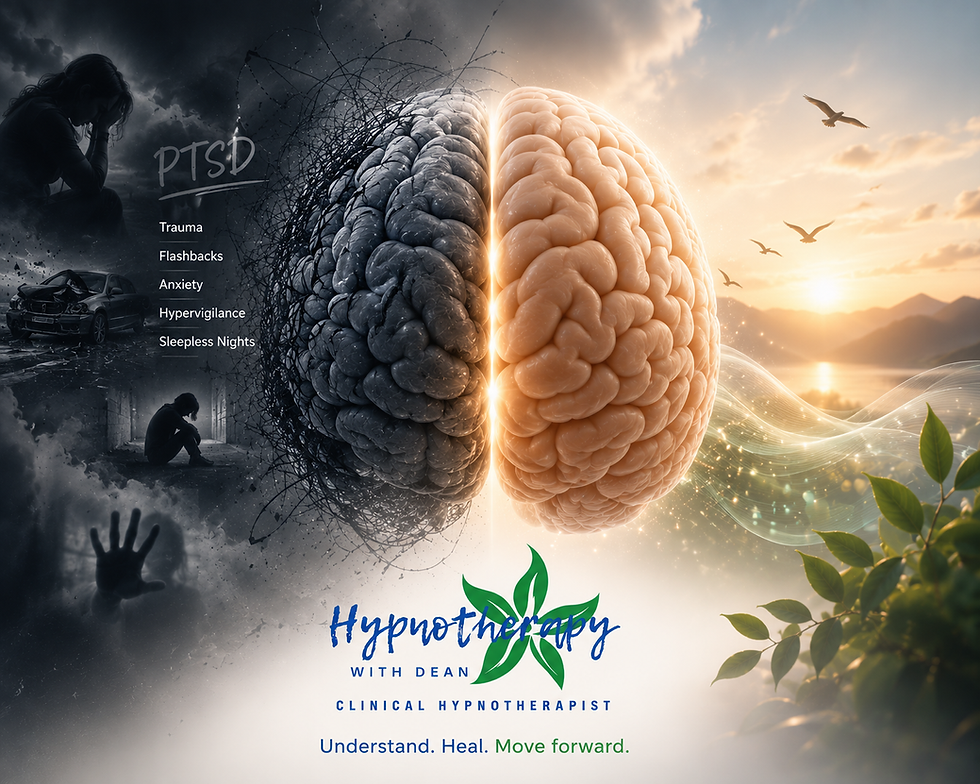
One of the things I've noticed over the years of working with clients is just how hard people with PTSD can be on themselves. Many arrive feeling frustrated, confused and often exhausted by what they're experiencing. They'll tell me that they know the event is over, they know they are safe, and yet they still feel anxious, on edge or unable to relax. Some are angry with themselves because they think they should have moved on by now. Others worry there is something wrong with them because they can't seem to switch off the thoughts, memories or feelings that continue to surface.
If any of that sounds familiar, I'd like to reassure you from the start that there is nothing wrong with you. What you're experiencing is not weakness, and it certainly isn't a failure on your part. In many ways, PTSD is the result of a brain that has become incredibly good at doing what it was designed to do: keeping you safe. The difficulty is that after a traumatic experience, the brain can sometimes struggle to recognise when the danger has passed.
Most people associate PTSD with military combat, and whilst it is certainly common amongst those who have served in the armed forces, trauma can come from many different experiences. I've spoken to clients whose symptoms began after road traffic accidents, difficult childbirths, serious illnesses, abusive relationships, workplace incidents, bullying, bereavement and traumatic experiences from childhood. Trauma isn't always about what happened; it's about how your brain experienced what happened. Two people can go through the same event and respond very differently, not because one is stronger than the other, but because every brain processes experiences in its own unique way.
To understand PTSD, it helps to understand a little about how the brain works. Deep inside the brain is a structure called the amygdala, often described as the brain's alarm system. Its job is to constantly scan the environment for potential threats and, when it detects danger, trigger the fight, flight or freeze response. This is an incredibly useful system. If you step into the road and a car suddenly appears, you don't want to stop and carefully analyse the situation. You need your brain to react immediately, and that's exactly what the amygdala is designed to do.
The problem is that trauma can sometimes cause this alarm system to become overly sensitive. I often explain it to clients using the analogy of a smoke alarm. Imagine your smoke alarm becomes so sensitive that it goes off every time somebody makes toast. The alarm isn't broken; it's doing exactly what it was designed to do. It's just become a little too good at spotting potential danger. PTSD can work in much the same way. The brain's alarm system becomes so focused on keeping you safe that it starts reacting to situations, thoughts, memories or triggers that aren't actually dangerous in the present moment.
This is why many people with PTSD say things like, "I know I'm safe, but I don't feel safe." Logically, they understand the danger has passed. Emotionally and physically, however, their nervous system is still responding as though the threat could return at any moment. That constant state of alertness can be exhausting. It can affect concentration, confidence, relationships, sleep and overall wellbeing. The body remains flooded with stress hormones such as adrenaline and cortisol, keeping it prepared for action even when there is no action required.
One of the most common issues I see with PTSD is poor sleep. In many ways, this makes perfect sense. If your brain believes there is danger nearby, it isn't particularly interested in allowing you to completely switch off. Many clients tell me they feel exhausted but can't relax. They lie awake replaying conversations, worrying about what might happen tomorrow or feeling constantly on edge. Others experience vivid dreams or nightmares that leave them waking feeling just as tired as when they went to bed. Unfortunately, poor sleep then creates a vicious cycle because a tired brain is far less able to cope with stress. The less we sleep, the more reactive we become, and the more reactive we become, the harder it is to sleep.
This is one of the reasons why understanding the brain is such an important part of solution focused hypnotherapy. I firmly believe that when people understand why they feel the way they do, they stop blaming themselves and start seeing their symptoms differently. Rather than viewing anxiety, hypervigilance or intrusive thoughts as signs that something is wrong with them, they begin to recognise them as signs that their brain is trying to protect them. That shift in understanding alone can often bring a huge sense of relief.
One thing that surprises many people is that solution focused hypnotherapy doesn't involve endlessly revisiting traumatic experiences. In fact, most clients are relieved to discover that we spend far more time focusing on where they want to be than repeatedly analysing where they've been. Whilst it's important to acknowledge what has happened, my focus is on helping clients understand how their brain works today and how we can begin creating the conditions for positive change.
The hypnosis itself is simply a state of focused relaxation. Contrary to what many people believe, hypnosis isn't about losing control or becoming unconscious. It's a completely natural state that most of us experience regularly. Think about becoming absorbed in a good book, getting lost in a film or driving a familiar route and suddenly realising you've arrived without consciously thinking about every turn. During hypnosis, the mind becomes deeply relaxed whilst remaining aware and responsive.
From a scientific perspective, this relaxed state is particularly interesting because it helps activate the parasympathetic nervous system, often referred to as the body's rest-and-digest system. This system acts as a natural counterbalance to the fight, flight and freeze response. As breathing slows, muscle tension reduces and the mind becomes calmer, the body receives a powerful message that it is safe. For somebody whose nervous system has spent months or even years operating in survival mode, these periods of deep relaxation can be incredibly valuable.
Research into neuroscience has shown us something fascinating over the last few decades. The brain is not fixed. For many years, scientists believed that once we reached adulthood, the brain was largely set in its ways. We now know that isn't true. The brain has an incredible ability to adapt and change throughout life, a process known as neuroplasticity. Every experience, thought and behaviour strengthens certain neural pathways. The more frequently something happens, the stronger those pathways become.
Think of it like walking through a field. The first time you walk across it, you leave only a faint trail. If you continue walking the same route every day, the path becomes clearer and easier to follow. Neural pathways work in a very similar way. When somebody spends a long time living in survival mode, the brain becomes exceptionally good at detecting threats. Those pathways become well established. The encouraging news is that the brain can also create new pathways. Every experience of calmness, safety, confidence and control helps strengthen alternative routes.
This is one of the reasons solution focused hypnotherapy places such a strong emphasis on what is already working well. Some people initially find this surprising because they expect therapy to focus exclusively on problems. However, the brain tends to move in the direction of what it focuses on. If we spend all our time analysing problems, we reinforce problem-focused thinking. By helping clients notice progress, recognise strengths and imagine a preferred future, we begin encouraging the brain to build pathways associated with hope, confidence and possibility.
Over time, many clients start noticing subtle changes. They may find themselves sleeping a little better, feeling slightly calmer in situations that would previously have caused anxiety or becoming less reactive to everyday stress. Often these changes are gradual, but that doesn't make them any less significant. Small changes tend to build upon one another, creating momentum and helping people regain confidence in their ability to cope.
One of the saddest things about PTSD is how small it can make someone's world become. People stop doing things they enjoy. They avoid places that remind them of difficult experiences. They withdraw from friends and family. Their focus shifts from living life to simply getting through it. Yet one of the most rewarding aspects of my work is seeing people slowly begin to reclaim those parts of themselves. As the brain becomes less focused on survival and more focused on living, opportunities begin to open up again.
Recovery doesn't mean forgetting what happened. It doesn't mean pretending the past never existed. Rather, it means helping the brain understand that the threat belongs in the past rather than the present. It means reducing the influence that old experiences have over current thoughts, feelings and behaviours. Most importantly, it means recognising that whilst trauma may be part of your story, it does not have to define your future.
If there is one message I hope you take away from this article, it is that change is possible. I've seen people arrive convinced that they will always feel the way they do, only to discover that with understanding, support and the right tools, things can improve. The brain's ability to adapt is extraordinary, and even when it has spent years stuck in survival mode, it retains the capacity to learn new patterns and develop healthier responses.
PTSD is not a sign that you are broken. It is a sign that your brain has been working incredibly hard to protect you. The challenge is helping it recognise that it no longer needs to stay on high alert. When that begins to happen, people often find that they sleep better, think more clearly, feel calmer and start reconnecting with the things that make life meaningful.
And that, for me, is what recovery is really about. Not simply surviving, but gradually rediscovering the confidence, freedom and peace of mind that allow you to fully engage with life again.


Comments